

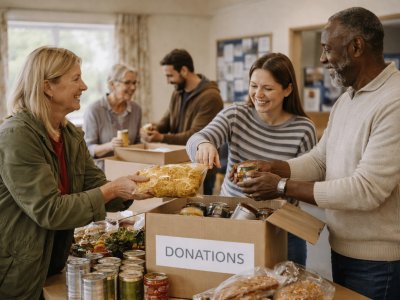
IN PRAISE OF VOLUNTEERS
The great cultural commentator of our times, Homer Simpson, once said: volunteering is for suckers, do you know so-called volunteers don’t even get paid?
In his own inimitable way, Homer spoke for a world where life is transactional and market-drive, where people have to be incentivised financially in order to do something for others. These kind of market forces permeate the culture in the way we speak, too. We say: ‘I don’t buy that’ or ‘I could use her’. But in doing so, we don’t get to the heart of what it means to be human. To do that takes volunteering.
Volunteers’ Week in 2026 is helpfully kicked off by Trinity Sunday, because this reminds us that God himself was the original and biggest volunteer, leaving the glory of heaven to become human in a violent and insecure world, intending this to lead to a sacrificial death that would liberate creation. Jesus’ self-understanding was deeply rooted in service and this has been the inspiration for how billions of people understand their lives. It has also grounded the idea of public service in countless countries.
Volunteers witness to a world beyond material gain, where community prevails over profit. Without the voluntary sector, this country would collapse and the most vulnerable would not just lose out badly; some would die. The voluntary sector is an unseen skeleton that holds us together. Without it, there would be far less between the individual and the State, a buffer which offers not just support for those in need, but protection from an overmighty State. Governments that want to control and monitor their people closely, like Russia and China, do not tolerate functioning voluntary sectors, because people might join together meaningfully and talk about how to make a better nation. A flourishing voluntary sector makes for a flourishing nation.
But we cannot take it for granted; every generation has to figure this out. In this decade alone, volunteering in the UK has taken an alarming hit. In 2025, the Centre for Ageing Better released a report that said since Covid, there are over one million fewer volunteers over the age of fifty. As older people volunteer more, this means we have lost a sizeable chunk of the nation’s volunteers. Something clearly happened over Covid. At the start of the pandemic, the talk was about a new cohort of volunteers coming through who would help to build back better once we got through lockdown. In reality, this new cohort largely disappeared, along with many longstanding volunteers. Changed work patterns, retirements, economic pressures and different lifestyle choices seem to have impacted. Put simply, people re-booted their lives after Covid, having had time to reflect.
Meanwhile, the corporate world has demanded ever more of those who work within it, depriving people of the space and energy they might have had to volunteer. This corporate audit is not spoken about much, but it cuts deeply and should be more of a source of shame than it is.
And yet, volunteering remains a source of deep personal fulfilment. All the evidence shows that people enjoy volunteering when they have made the choice to help. Making a difference to other people’s lives and meeting new people are top of the list and the more time people give, the more they enjoy the role, apparently. The mental health of volunteers also improves, partly because people feel more connected and less isolated.
There are recorded downsides, of course. Volunteering can take too much of people’s time and they can feel pressured to do more. I suspect that feels more acute, post-Covid. As fewer people volunteer, those who remain have to do more.
This got me thinking about what volunteering looks like in the Bible, and on the face of it, it’s surprisingly thin. The case that jumps out is Isaiah, who has a vision of heaven where God asks who will go in his name to speak to the people and Isaiah responds: here I am, send me. In other places, God goes looking for volunteers but they usually look down at the floor in front of them when he does – a bit like we do in meetings when the appeal for volunteers is made. Moses, Gideon and Jonah stand out. David volunteered to fight Goliath, but he was motivated partly by the rewards on offer, including marriage to the king’s daughter.
The thing is: volunteering in the Bible is so closely linked to being called by God. When a person has a sense that God might want them to do something, they often feel a compulsion to do it. The dividing line between volunteering and vocation can be paper thin. This explains the remarkable success of the Church as a voluntary organisation. We volunteer as a way of showing our love for God, as well as for our neighbour.
OK, we sometimes volunteer because we have had our arm twisted in that nice, polite, Christian way. And carry on volunteering because no-one else steps up. That’s why I want to express my admiration, gratitude and respect for those who volunteer in churches and in the wider community. At times I am in awe, when I hear what people do in church: the loving kindness, the professionalism, the hard grind of working when you could be resting. Your volunteering shows the love within your soul and it reflects the light of the God who volunteered to rescue a world that could not rescue itself.
Happy volunteers week. And may all your rotas be blessed with names against them.
POPULAR ARTICLES
Why Violence Is Declining In The West But There Is No Guarantee It Will ContinueTo

Obama's Covert Wars
The use of drones is going to change warfare out of all recognition in the next decades.

Through A Glass Starkly
Images of traumatic incidents caught on mobile phone can be put to remarkable effect.

What Are British Values?
Is there a British identity and if so, what has shaped the values and institutions that form it?